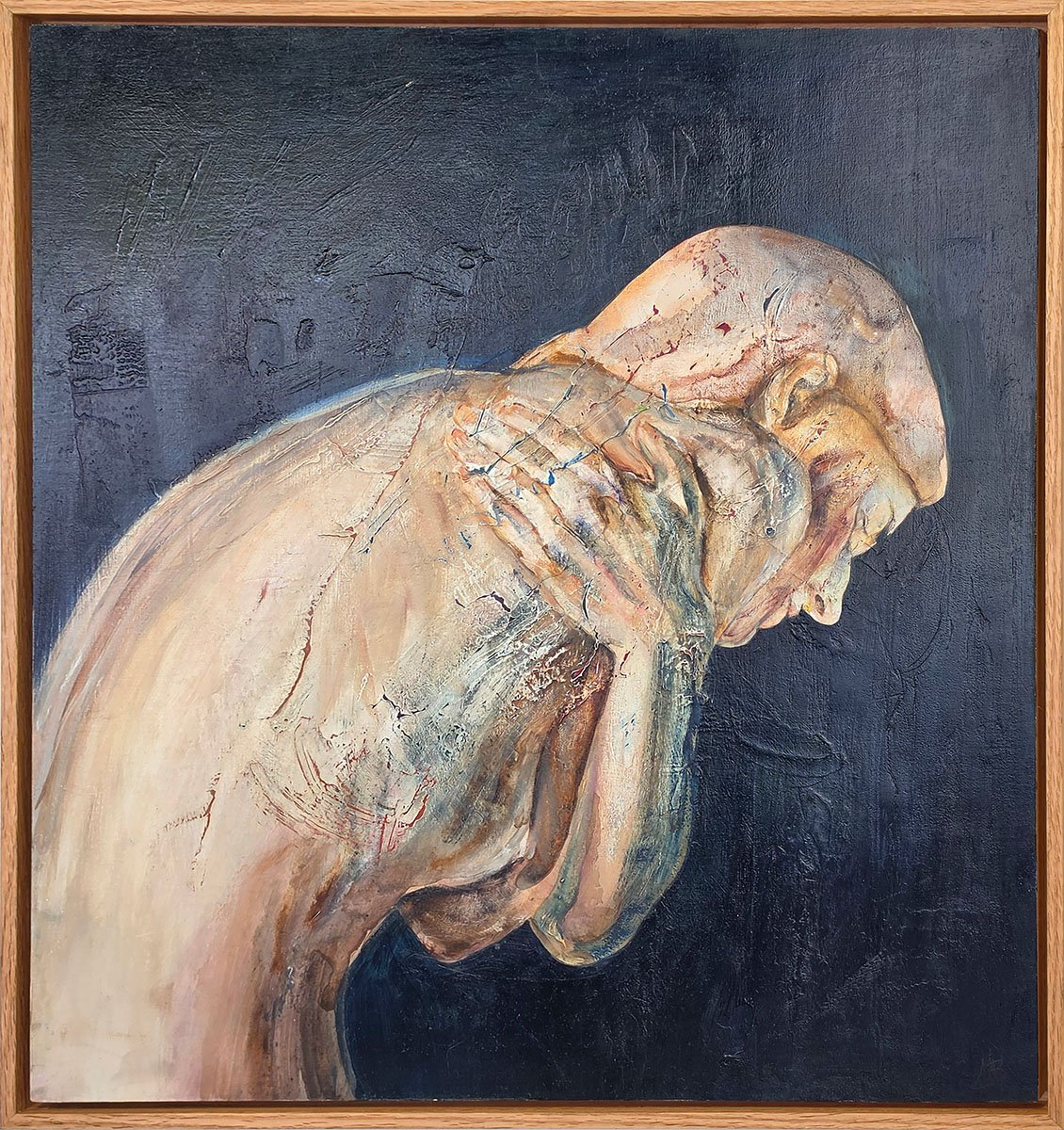
Matteo Bernasconi Reprise


We are delighted to present: ‘Merric Boyd – Works on Paper‘.
William Merric Boyd (1888-1959) is perhaps best known as the father of artists Arthur, Guy, and David, but Merric was a talented artist in his own right, and without this nurturing artistic upbringing, the Boyd brothers may have never left the legacy that they did. Merric is often referred to as the father of Australian studio pottery and alongside his wife and children he created a tremendous output, with works now held across all major collections in Australia.
He was born in Melbourne’s bayside suburb of St. Kilda. Like his own children, he was also born into an artistic family and was a key link in what would become an artistic dynasty. His father, Arthur Merric Boyd (1862-1940), was a member of the influential Heidelberg School and his mother, Emma Minnie Boyd (1858-1936), exhibited with the Royal Academy in London from the late 19th century.
Merric attended the National Gallery School in 1910, and although later renowned as a potter, he studied drawing during his semester there. It was here that he met fellow artist Doris Gough who he would go on to marry in 1915. They would frequently collaborate on works together with Doris often painting her husband’s pottery. After his formal training, his parents bought him a block of land in the outer-suburb of Murrumbeena where he drew up plans for the family home ‘Open Country’. The plans naturally included a studio for his practice in addition to the homestead.
During the First World War he enlisted as an Air Mechanic in the Australian Flying Corps and was sent to the UK. He never saw active service and at the end of the war he took the opportunity to complete pottery studies at the Stoke Technical School as part of a repatriation scheme. He later received an invitation from Josiah Wedgewood to the potteries at Stoke-on-Trent.
Throughout his life, the artist struggled with epilepsy. The location of the plot at Murrumbeena was even chosen by his parents for its vicinity to neurologist Dr John Springthorpe. By the late 1940s Merric’s health had deteriorated to a level that restricted him from the arduous pottery process. From this period until his death in 1959, Merric focused on drawing. In these later years he produced small works on paper often depicting charming pastoral and coastal scenes, no doubt inspired by his early Bayside upbringing and many years spent at Open Country.
Alongisde this selection of Merric Boyd works on paper we are delighted to present a selection of incredibly rare Hermia Boyd oil on glass paintings alongside David Boyd’s ‘Over the Mountains‘ (1957/8). The 5 paintings by Hermia completed in the mid-late 1960s are delicately handled and finely executed on panes of glass which imbues the works with a silky finish. ‘Over the Mountains‘ is a highly significant work from the artist’s seminal ‘Explorers‘ series exhibited at Australian Galleries in 1958. All works exhibited were previously held in the David and Hermia Boyd private collection.
For further information on individual artworks click here.

Fox Galleries is delighted to present Archive; a selection of paintings by the renowned Victor Rubin. Completed at different stages of his long and successful career. This exhibition provides a glimpse into the artist’s practice over the decades, bringing together contemporary works as well as those from the archives. This style of exhibition mirrors the artist’s practice in many ways. While a painting was first completed in the 1970s, the subsequent iteration has been added to and gradually refined over decades. These paintings can be viewed as palimpsests; a testament to the passage of time.
Rubin is a Sydney-born artist who joined John Olsen’s Bakery Art School while just a teenager and thrived under the master’s tutelage. Rubin’s work has been exhibited in over fifty solo exhibitions and numerous group exhibitions including Vox Pop – Into the Eighties at the National Gallery of Victoria in 1983/4, Australian Perspecta at the Art Gallery of New South Wales in 1983 and 1985, Identities: Art from Australia at the Taipei Fine Arts Museum in Taiwan in 1994, and Return of the White Bull at Geelong Gallery in 2004.
Rubin’s works are held in numerous public collections including the Australian National Gallery, Canberra, NGV, AGNSW, Queensland Art Gallery, Museum of Contemporary Art Sydney, Heide Museum of Modern Art, Auckland City Art Gallery, New Zealand. Additionally his work is found in significant private collections such as the late Patrick White and Miles Davis. Rubin has been a finalist in the Art Gallery of New South Wals’ Sulman Prize on numerous occasions and his portrait of his mentor John Olsen was exhibited at the 2010 Archibald Prize.

The mythological tale of Venus and Mars represents the infamous pairing of love and destruction. In both ancient mythology and astrology the figures are noted as ‘the cosmic lovers’ . Venus was the goddess of love and Mars the god of war – entangled in a forbidden love affair. Venus is a symbol of love, peace and harmony whilst Mars represents desire, passion and intensity. This ancient story has influenced poets, philosophers and artists for centuries.
Brendan Kelly and Esther Erlich have illustrated this powerful interplay within their collaborative exhibition ‘Venus x Mars‘. The interaction between the artist’s opposing styles has captured the essence of this ancient tale. Kelly is expressive with his robust, quick linework. Whereas Elrich’s composition holds space for softness as the audience is immediately drawn into the figure’s gaze.
In each artwork the figures associated with the ancient story are present. This includes renditions of Venus and Mars, cherubs, angels, and acts of war. Kelly’s works on paper provide quick glimpses with a sense of urgency. Ink and charcoal do not leave much room for error, therefore the works were completed as an immediate reaction. Kelly is highly regarded for his ability to evoke raw emotion and immediacy in each of his paintings. On the opposing side, Erlich places focus on creating alluring facial features. Each face is presented differently but all succeed in pulling the viewer into their gaze. Esther Erlich’s artworks present the side of love and peace, whilst Brendan Kelly’s artwork evokes passion and desire.
Brendan Kelly, based in Byron Bay, has attracted critical and commercial acclaim for a distinctive style which draws on both his immediate regional environment and an inner landscape of raw emotion. It is not surprising that his paintings have been compared favourably to the great Australian post-war modernist artists like Sidney Nolan and Albert Tucker.
Esther Erlich is a Melbourne based artist celebrated for over three decades for her distinctive portraits. Expressive and alluring, Erlich’s figures demand attention from their viewers. Her provocatively beautiful faces are vivid apparitions above abstracted bodies that exist in no space or time.
Erlich has won the prestigious Doug Moran Portrait Prize (1998), the People’s Choice Award, Archibald Prize (2000) and has been a finalist in the Archibald Prize and the Portia Geach Memorial Award multiple times. She is represented in both public and private collections nationally and abroad, including the CAE Victoria, Performing Arts Museum, National Portrait Gallery, ALP Building A.C.T., and the National Library Canberra.

June 2026
Fox Galleries is pleased to present an online-only selection of work by our represented artists set to evoke the sense of Winter.
This season conjures simultaneous feelings of lonlieness and warmth. A period which allows people to slow down, as the streets become emptier. Each day feels shorter than the last as darkness expands over our cities. Although the cold pushes people indoors, it conjures a newfound closeness to one another.

“‘Changing States’ builds on ideas developed during my 2024 Edith Cowan University and Western Australian Parliament Artist in Residence program, as well as my recent group exhibition Paper Thin, Skin Deep at Mundaring Arts Centre 2026 curated by Annette Peterson. The work explores what it means to inhabit a body—through material, metaphorical, and cultural layers of skin.
With over thirty years of experience across Australasia, including a decade working in Singapore, my practice examines my relationship to place within the Western Australian landscape. Originally from Melbourne, where I studied at the Victorian College of the Arts and majored in Printmaking, this exhibition marks a full-circle return—bringing together the journeys and experiences that have shaped my work internationally.
This body of work contributes to the development of new work for a recent commission from Curtin University. I draw on the symbol of Maali (the black swan) and the meeting of two rivers at Derbarl Yerrigan, where salt water meets fresh—reflecting the convergence and tension between colonial, immigrant, and Aboriginal cultures. Etchings of Maali layered over watercolour monoprints explore pressure, resilience, and cultural compression, where histories overlap, merge, and leave lasting traces.
Material is integral to the work. Japanese Kozo paper offers both delicacy and strength, echoing the healing qualities of skin and the layered fabric of culture. Printmaking becomes a metaphor for imprinting—marks made under pressure, fragile yet enduring.” (Jo Darvall, 2026)
The esteemed filmmaker Peter Lamont has spent the previous couple of years documenting the life and practise of Jo Darvall. To coincide with the launch of Darvall’s exhibition ‘Changing States‘, the film is now available for viewing.
To watch the film in full please click here.


© 2026 Fox Galleries
Recent Comments